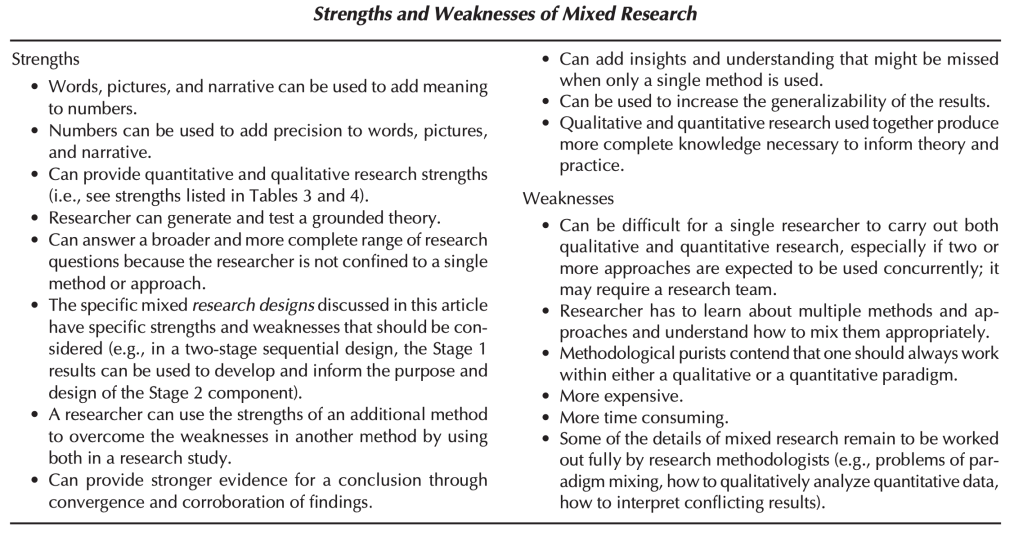
This paper explores the relationship between quantitive and qualitative purists and the methods that they subsequently subscribe too as researchers. The writers explore the concept that accommodation between paradigms is impossible, from the point of view of purists.
Johnson goes on to explain the benefits of mixed methodology research and how this might (with careful planning) be possible. Today’s research world is becoming increasingly inter- disciplinary, complex, and dynamic; therefore, many researchers need to complement one method with another, and all researchers need a solid understanding of multiple methods used by other scholars to facilitate communication, to promote collaboration, and to provide superior research (Johnson, 2004).
Philosophically, mixed research makes use of the pragmatic method and system of philosophy. Its logic of inquiry includes the use of induction (or discovery of patterns), deduction (testing of theories and hypotheses), and abduction (uncovering and relying on the best of a set of explanations for understanding one’s results) (e.g., de Waal, 2001).
Through reading the article, one thing rings true for me – being a master of both and being able to hold yourself to the account required to be able to draw meaningful conclusion from either of them.
From the article:
“Our mixed methods research process model comprises eight dis- tinct steps: (1) determine the research question; (2) determine whether a mixed design is appropriate; (3) select the mixed- method or mixed-model research design; (4) collect the data; (5) analyze the data; (6) interpret the data; (7) legitimate the data; and (8) draw conclusions (if warranted) and write the final report.” Johnson (2004)
When considering this alongside my proposed research question, it draws the importance of question design into account. One must have a question and a clear idea in which camp they sit. For me, I am begin to align myself to that of a positivist, but with some strong pull towards that of a interpretivist, too. If I had to really drill down into it, I would probably say that I sit closer to a positivist which actually goes against much of my epistemological beliefs…
Not my best dissection of an article, but I’m sure at some point I will revisit this.
DOI: https://journals.sagepub.com/doi/pdf/10.3102/0013189X033007014



 Stephen Mitchell