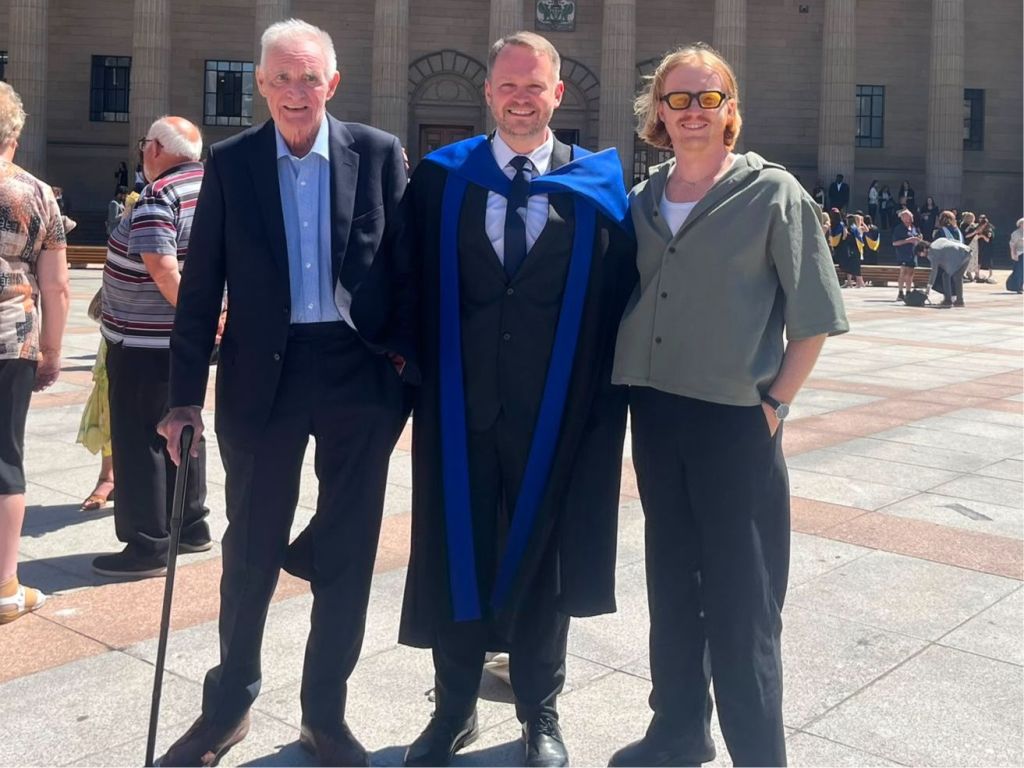
This week, I graduated with a Doctorate in Education from the University of Dundee.
Like many milestones, the event itself passed remarkably quickly. There was a gown, a stage, a handshake and a photograph. Then, almost as suddenly as it had arrived, it was over. What has stayed with me is not the ceremony itself, but the thinking that followed.
Over the course of my studies, I paid around £41,000 in fees. That figure has occupied my thoughts more than I expected it to.
The easy interpretation would be to see the doctorate as a transaction. A fee is paid, a qualification is awarded and a certificate arrives in the post. Yet that feels entirely inadequate as a description of what has happened over the last few years. The value of the experience cannot be captured in a piece of paper, nor can it be reduced to the letters that now appear after my name.
Much of what I gained came through conversations. I was fortunate to work with a supervisor whose insight, challenge and generosity of spirit helped me to think more carefully than I had thought before. Ideas that initially seemed settled became more complicated; assumptions that I held with confidence became less certain; and questions that appeared straightforward revealed themselves to be far richer than I had first imagined. That kind of intellectual companionship is difficult to quantify, yet it sits at the heart of what makes advanced study worthwhile.
And still, the question remains… why does access to that experience come at such a significant cost?
I ask this not because I begrudge the fees, nor because I fail to recognise that universities require funding. Research, teaching and academic expertise are not created without investment. The question is not whether higher education should cost money. The question is who decides how much it should cost and, perhaps more importantly, who is excluded when that price is set.
As educators, we are always speaking about the transformative power of learning. We describe education as a route to greater understanding, greater opportunity and, in some cases, greater freedom. We celebrate curiosity and encourage young people to pursue knowledge wherever it might lead. Yet there is a tension here that is difficult to ignore. If education is something we value collectively, why does access to it become increasingly dependent upon an individual’s ability to pay as they progress through the system?
I am conscious that there are no simple answers. Public money is finite and universities are operating within increasingly difficult financial circumstances (Dundee is in significant financial disarray – something which is playing out very publicly in the press, for example). Any discussion about free education quickly becomes a discussion about taxation, political priorities and competing demands. Nevertheless, I find myself returning to a question that feels worth asking.
What would it mean to organise education around the principle that learning is a public good rather than a private purchase?
The doctorate has left me with more knowledge than I possessed when I began. More importantly, it has left me with better questions. Perhaps that is one of the most valuable outcomes of education: not certainty, but a willingness to continue wondering about things that might otherwise be taken for granted.
As I look at the certificate now framed on my office wall, I feel an enormous sense of gratitude for the opportunity to undertake the journey. At the same time, I cannot help but think about those for whom the journey was never really available in the first place.
For a profession that places such faith in the power of education, that feels like a question worth sitting with.





Leave a comment