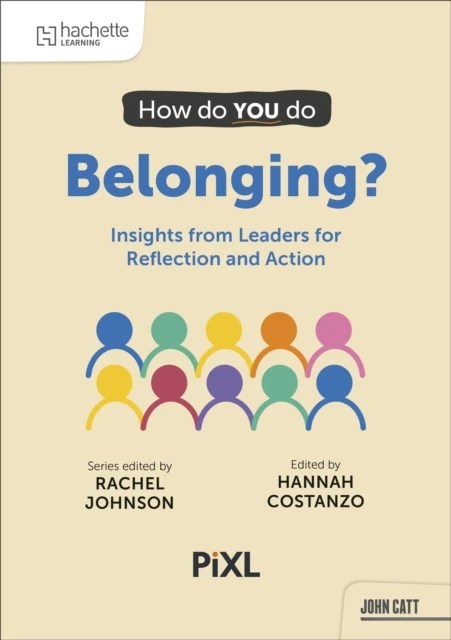
Reflections on contributing to How to Do Belonging in Schools
It was a genuine privilege to be invited to contribute to How to Do Belonging in Schools, not least because the invitation provided an opportunity to reflect on something that I believe is fundamental to the purpose of education, but which can sometimes become lost amongst the many competing demands placed upon schools. We spend a great deal of time considering what children should know, what they should be able to do and how we might measure their progress, yet we perhaps spend less time considering the extent to which they feel connected to the communities in which that learning takes place.
This matters because belonging is not simply a desirable addition to a successful education; it is one of the conditions that makes a successful education possible. When children feel secure in their relationships, confident that their contributions are valued and assured that they have a legitimate place within their school community, we create the conditions in which they are more likely to participate, take intellectual risks and engage meaningfully with learning.
At King’s Cross Academy, we have been thinking carefully about what this means in practice, particularly given the wonderfully diverse community that we serve and the responsibility we have to ensure that our understanding of belonging extends beyond the experiences of those children for whom school already feels like a comfortable and familiar place.
Beyond the language of inclusion
One of the challenges with discussions about belonging is that the term can become interchangeable with inclusion, when in fact there are some important distinctions between the two.
We can develop inclusive policies, make reasonable adjustments, adapt our teaching and provide additional support, all of which are essential features of a school committed to equity, without necessarily ensuring that every child experiences a genuine sense of belonging. Inclusion can sometimes be understood in terms of what we provide, whereas belonging requires us to consider how those provisions are experienced by the people they are intended to support.
A child might be present in a classroom, accessing an appropriately adapted curriculum and receiving carefully planned interventions, while still feeling that they are somehow on the margins of the wider school community. Equally, a child might be achieving well academically while experiencing little sense of connection to their peers or feeling that aspects of their identity are neither understood nor represented within school life.
This distinction has become increasingly important in our thinking.
Our work on inclusive pedagogy, adaptive teaching and the development of our SEND provision is therefore about more than ensuring that children can access the curriculum, important though that is. It is also about creating a culture in which difference is understood as an ordinary and valued feature of school life, rather than something that must continually be accommodated or explained.
There is a subtle but significant difference between a child feeling that a school has made space for them and feeling that the school was always intended to be a place for someone like them.
Creating the conditions for belonging
Although belonging is often discussed in relation to relationships, I think it is important that we do not overlook the role of the wider school environment and the opportunities that children have to experience success, connection and enjoyment.
At King’s Cross Academy, our curriculum extends deliberately beyond the traditional academic subjects, with opportunities for children to engage in music, drama, the arts, sport and a range of wider experiences that we believe should be an entitlement for every child.
There is an important equity argument here, because the opportunities through which children discover their interests, develop friendships and establish a sense of identity should not depend upon the resources available to them outside school. For some children, their strongest connection to school might emerge through academic learning, while for others it might develop through performing, creating, playing an instrument or discovering an aptitude that had previously gone unrecognised.
Our developing work with OPAL is another example of how we are considering belonging beyond the classroom, particularly in relation to the opportunities that play provides for children to build relationships, negotiate social situations and participate in shared experiences.
Playtimes occupy a substantial proportion of children’s experience of school, yet they can sometimes receive comparatively little attention when we think about inclusion and school culture. For children who find unstructured social situations challenging, the playground can be a place of considerable uncertainty, and the extent to which we create inclusive, engaging and appropriately supported play environments can make an enormous difference to their experience of the school day.
We are still developing this work, but the underlying principle is an important one: if we are serious about belonging, we need to consider the entirety of children’s experiences rather than focusing exclusively on what happens during lessons.
Belonging is relational
Of course, none of this can be separated from the relationships that exist within a school community, and I suspect that many of the most significant influences on children’s sense of belonging are found in the ordinary interactions that take place throughout the day.
The way an adult responds when a child makes a mistake, the extent to which a child’s interests are remembered, the language used when discussing behaviour and the willingness of staff to listen carefully when something has gone wrong all contribute to the messages children receive about their place within the community.
These interactions are particularly important when children experience difficulties, because it is often at precisely these moments that our commitment to belonging is most meaningfully tested. It is relatively straightforward to communicate warmth and acceptance when children are meeting our expectations, but considerably more challenging, and arguably more important, to maintain that sense of connection when behaviour becomes difficult or relationships are strained.
This does not mean abandoning boundaries or lowering expectations, but rather recognising that clear expectations and a strong sense of belonging are not competing priorities. Children need to understand the responsibilities that come with being part of a community, while also knowing that making mistakes or experiencing difficulties does not diminish their fundamental place within it.
There is also an important connection here with the experiences of families, particularly in communities where relationships with educational institutions may have been shaped by previous experiences of exclusion, disadvantage or a sense that their perspectives have not always been understood.
In this sense, belonging is not something that schools can create for children independently of the wider communities to which they belong.
An ongoing responsibility
One of the things I have come to appreciate through our work at King’s Cross Academy is that belonging cannot be secured through a single initiative, however thoughtfully designed, nor can it be assumed simply because a school has a warm atmosphere or a strong set of values.
It requires us to remain curious about the experiences of children and families, particularly those whose perspectives may be less visible within the usual mechanisms through which schools gather feedback.
We need to be willing to ask difficult questions about whose needs are most readily met by our existing systems, whose experiences might be overlooked and whether some of the practices we take for granted unintentionally create barriers to participation.
There is also a danger that, in seeking to develop belonging, schools become preoccupied with the visible manifestations of community, such as celebrations, displays and special events, without giving sufficient attention to the less visible aspects of school culture that shape children’s everyday experiences.
These activities can be valuable, but their impact depends upon the relationships, expectations and underlying culture that surround them.
Our school motto at King’s Cross Academy is Love Learning Together, and I have increasingly come to think that the word ‘together’ carries a particularly important responsibility. It suggests that education is not simply an individual endeavour, but a shared experience in which our learning, relationships and sense of identity are shaped by the people around us.
For that to be meaningful, we must ensure that every child has the opportunity to participate in that shared experience, rather than simply being present while it happens around them.
Continuing the conversation
Contributing to How to Do Belonging in Schools has provided a welcome opportunity to reflect on the work we are undertaking at King’s Cross Academy, but perhaps more importantly, it has reinforced my belief that belonging is something we should continue to question, examine and develop.
I am proud of the inclusive community we are building, while remaining conscious that there will always be children for whom belonging feels less secure, families who experience barriers to engagement and aspects of our practice that would benefit from further reflection.
There is considerable value in bringing together the experiences and perspectives of educators who are thinking seriously about these questions, because it reminds us that the work of developing belonging is both deeply contextual and grounded in some shared principles about the purpose of education.
Schools are, of course, places of learning, and we have a responsibility to ensure that every child receives an ambitious, intellectually rich education that opens doors to future opportunities. But if we want children to engage fully with that education, we must also pay attention to the relationships, experiences and conditions that enable them to see themselves as valued members of the communities in which they learn.
Perhaps the most useful question we can ask ourselves is not simply whether we believe our schools are inclusive, but whether every child who attends them would describe their experience in the same way.
It is a question that deserves our continued attention, because belonging is not something we can declare on behalf of children; it is something they must be able to experience for themselves.





Leave a Reply