Yesterday, I had the privilege of contributing to the LAMDA Teachers’ Conference, where I explored the relationship between oracy, drama and the opportunities that exist for schools to think more carefully about how we develop children’s spoken language. It was a particularly rewarding experience, not least because it reinforced something I have been thinking about for some time: as oracy becomes an increasingly prominent part of the educational conversation, we have an opportunity to reconsider the place of drama within the curriculum, and perhaps to recognise the contribution that drama practitioners have been making to children’s communication, thinking and learning for many years.
I have delivered variations of this training to a wide range of audiences, including teachers, school leaders and colleagues working across different areas of education, and each time I am struck by the different perspectives that participants bring to the discussion. However, yesterday’s audience of drama and communication specialists engaged with the material at a level of detail and nuance that was particularly interesting, and which reminded me just how much mainstream education has to learn from those whose professional expertise lies in the deliberate development of spoken communication.
There is something rather curious about the current enthusiasm for oracy, because many of the approaches that schools are now beginning to explore have been familiar to drama practitioners for generations. The explicit teaching of vocal expression, the purposeful use of silence, the relationship between physical communication and meaning, the importance of audience and the ability to adopt and interrogate different perspectives are all central to drama education, yet they are not always recognised as such within broader conversations about teaching and learning.
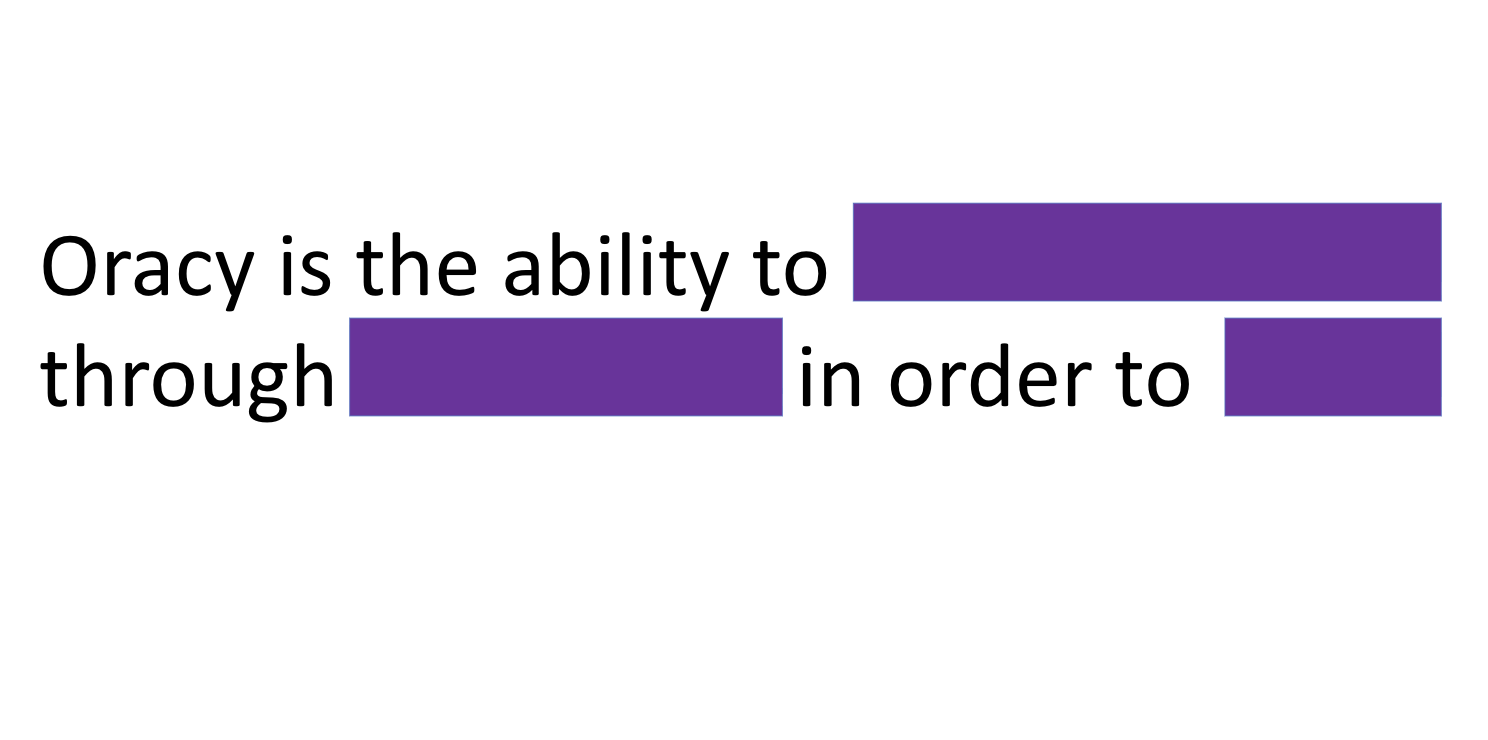
I delivered this slide and the drama practitioners in the room were able to come up with a much more deliverable definition than I have seen in other training courses that I have facilitated.
Perhaps, then, the growing interest in oracy provides an opportunity not simply to introduce something new into schools, but to reconnect with a discipline whose contribution has not always been sufficiently understood or valued.
More than confidence and performance
One of the recurring challenges in discussions about oracy is the tendency to associate effective spoken communication primarily with confidence, particularly the confidence to speak publicly or contribute to discussions. While confidence is undoubtedly important, it is not the same as competence, and children who appear comfortable speaking in front of others are not necessarily demonstrating the range of knowledge and skills that underpin effective communication.
This is where I think drama practitioners have something particularly valuable to contribute, because their understanding of communication is often considerably more precise than the language we typically use in classrooms and thats because oracy is the bridge which connects both of these domains beautifully.

When a drama teacher asks a child to reconsider the pace of a line, experiment with a pause, adjust their physical positioning or think more carefully about the intended audience, they are engaging in explicit teaching of communication. These decisions are not simply matters of style or performance, but deliberate choices about how meaning is constructed, conveyed and interpreted.
Similarly, when children explore a character’s motivation, consider an alternative interpretation or respond spontaneously to an unexpected development within a dramatic situation, they are drawing upon a range of cognitive and linguistic processes that extend well beyond the ability to speak fluently.
What struck me during yesterday’s discussions was the extent to which drama practitioners understood these distinctions intuitively, while also possessing the technical knowledge to explain why particular approaches might be effective. Their work is not simply about encouraging children to express themselves, but about helping them understand how communication works and how it can be shaped for different purposes.
For schools seeking to develop oracy more deliberately, this expertise should be enormously valuable.
Learning to talk and learning through talk
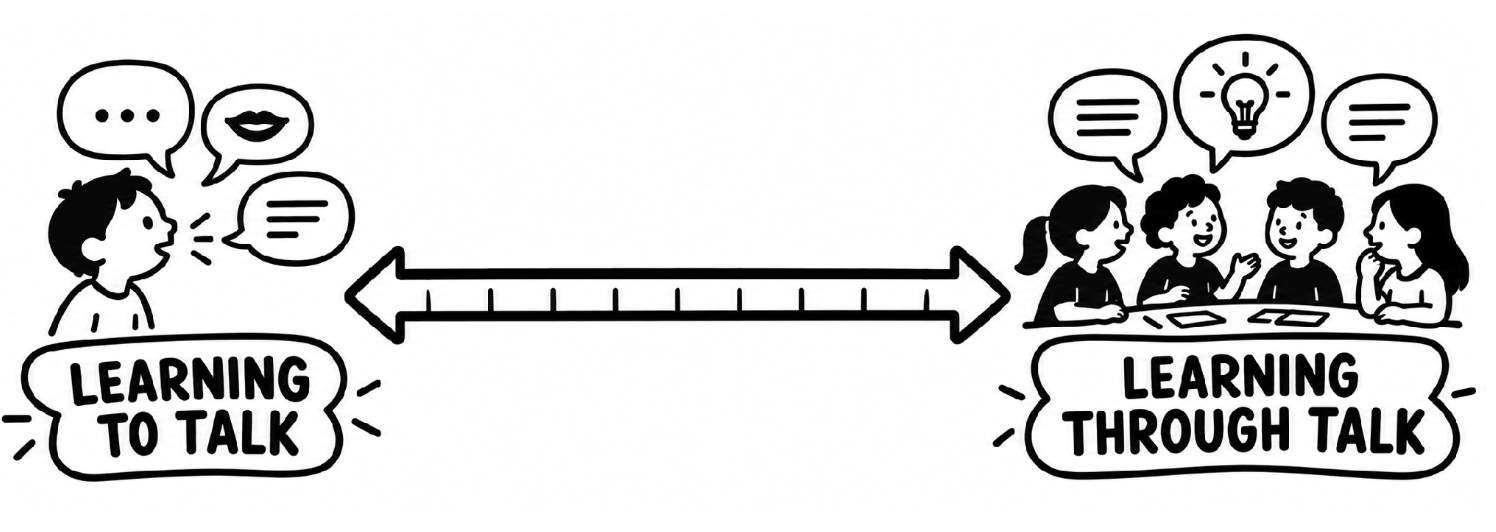
A central part of my session explored the relationship between learning to talk and learning through talk, a distinction that I think offers a particularly useful way of understanding the contribution that drama can make across the curriculum.
When we teach children to consider their audience, structure an argument, articulate their words or use emphasis to communicate meaning, spoken language becomes the explicit object of teaching. We are developing the knowledge and skills that enable children to communicate more effectively, and we should be as deliberate about this teaching as we are when introducing new vocabulary, mathematical concepts or approaches to writing.
However, talk is also one of the means through which children develop understanding, particularly when they are required to explain their thinking, encounter alternative perspectives and reconsider their ideas in response to others.
Drama occupies a particularly interesting position within this relationship because it can bring both dimensions together in ways that feel purposeful and authentic.
A child exploring a character’s motivation through improvisation might be developing their ability to listen, respond and adapt their language, while simultaneously deepening their understanding of the text, the character and the wider themes being explored. Equally, a group preparing a dramatic interpretation might need to negotiate meaning, justify decisions and consider competing perspectives, all while developing increasingly sophisticated control over how they communicate their ideas.
Yesterday, we explored this relationship through a series of practical scenarios, asking participants to consider where different activities might sit along a continuum between learning to talk and learning through talk. What emerged was not a simple division between two approaches, but a much more interesting discussion about intention, pedagogy and the decisions teachers make when designing learning experiences.
The distinction matters because it encourages us to think beyond whether children are talking and towards a more demanding question about what they are learning as a result.
The expertise we have overlooked
One of my strongest reflections from the conference is that drama practitioners often possess an exceptionally detailed understanding of aspects of teaching that are now receiving renewed attention within mainstream education.
Their work requires careful consideration of participation, audience, interpretation, expression and the relationship between language and meaning, alongside a sophisticated understanding of how children develop these capabilities through modelling, rehearsal, feedback and repeated practice.
These are not peripheral concerns, but matters that sit at the heart of effective teaching.
Yet drama has not always enjoyed the status within the school curriculum that this expertise might suggest it deserves. In many settings, opportunities for drama have become increasingly dependent upon individual teachers’ interests, the availability of specialist provision or the extent to which schools can protect time for creative subjects within a crowded curriculum.
Where drama does exist, it can sometimes be understood primarily in terms of performance, enrichment or the development of confidence, rather than being recognised as a rigorous discipline with its own knowledge, pedagogy and contribution to children’s intellectual development.
I wonder whether the current focus on oracy offers an opportunity to challenge some of these assumptions, particularly if we are prepared to recognise that developing children’s spoken language requires more than simply increasing the frequency of classroom discussion.
It requires expertise, intentional teaching and a sufficiently detailed understanding of communication to identify what children need to learn next.
Drama practitioners have a great deal to offer in this respect, and I suspect that the relationship between drama and oracy has the potential to be far more productive when it is understood as a genuine professional exchange, rather than an attempt to borrow a few engaging activities for classroom use.
An opportunity worth taking
I left yesterday’s conference feeling enormously encouraged, partly because of the quality of the conversations and the generosity with which colleagues shared their expertise, but also because it reinforced my sense that there is an important opportunity emerging for drama education.
As schools become increasingly interested in the deliberate development of oracy, we have an opportunity to draw upon a body of professional knowledge that has sometimes existed at the margins of mainstream curriculum discussions, despite its obvious relevance to how children learn, communicate and participate.
The challenge will be to ensure that drama is not simply invited into the conversation because it offers engaging activities or opportunities for children to perform, but because we recognise the intellectual and pedagogical contribution it can make.
There is much that classroom teachers can learn from drama practitioners about the deliberate teaching of communication, just as there is considerable potential for drama specialists to contribute to wider discussions about curriculum, assessment and the development of children’s thinking.
I am grateful to LAMDA for the invitation to contribute to the conference and to the colleagues who participated so thoughtfully in the session, particularly those whose questions and observations challenged me to consider familiar ideas from a different perspective.
Having delivered this training many times, I had expected to share some thinking about oracy and its implications for teaching, but I came away reminded that some of the most valuable professional learning happens when we bring different areas of expertise into conversation with one another.
Drama is being invited back into the curriculum, and oracy may well be the key that opens the door. What matters now is that we recognise the depth of expertise waiting on the other side.


Leave a Reply